Product Introduction
The intelligent dehumidification device adopts semiconductor refrigeration dehumidification. It actively draws humid air from an enclosed space into the dehumidification duct with a fan. The water vapor in the air condenses into water through the semiconductor refrigeration mechanism and is then discharged out of the cabinet via a drain pipe, achieving excellent dehumidification results. By reducing the moisture content in the air, both relative and absolute humidity decrease simultaneously, almost without raising the temperature. This avoids the adverse effects of temperature differences, fundamentally eliminating or reducing the occurrence of accidents, and preventing accelerated aging of internal components and the cabinet due to high temperatures. The intelligent dehumidification device changes the passive anti-condensation approach to an active condensation-inducing method, effectively preventing potential hazards such as component aging, reduced insulation strength, secondary terminal breakdown, material mildew, and steel structure corrosion inside the cabinet, ensuring the safe operation of the power grid.
Condensation inside the equipment can cause electrical creepage and flashover accidents, which generally occur under the following conditions: First, in regions with high humidity and large temperature variations, the bottom of switch cabinets becomes damp, and some cable trenches even accumulate water; second, some switch cabinets are located in basements with high humidity, where the temperature inside the cabinet (especially near the ground) is lower than the ambient temperature; third, when equipment is temporarily out of service, the temperature inside the electrical cabinet becomes lower than the surrounding ambient temperature, making condensation highly likely on its surface. In such cases, accidents will occur once power is restored. To ensure the safe operation of the power grid system and the long service life and safe use of electrical equipment, the power system has raised higher requirements for moisture and condensation prevention inside cabinets.
Application Scope
● Electrical equipment such as GIS control cabinets, high/low voltage control cabinets, high/low voltage switch cabinets, ring main units, outdoor terminal boxes, mechanical control cabinets, box-type substations, and dry-type substations.
● Moisture-proof storage for integrated circuits, crystals, liquid crystal devices, ceramic components, resistors and capacitors, active components, connectors, SMD devices, CPUs, and computer boards.
● Moisture-proof management of physical and chemical instruments, experimental materials, and insulating materials; moisture-proof storage of chemicals, pharmaceuticals, food, fibers, and biological agents.
Product Features
● Compact size, light weight, and easy installation.
● Switchable between automatic and manual dehumidification modes; adjustable temperature and dehumidification activation values.
● The dehumidification duct actively induces condensation and discharges gas to achieve heating and dehumidification, effectively managing moisture and preventing condensation in enclosed electrical spaces.
● Humidity and temperature sensors sample data 24/7, automatically inducing condensation when exceeding set activation values.
● Humidity and temperature settings have a memory function and will not be lost due to power outages.
● Fault display function allows quick troubleshooting to ensure normal operation.
● Uses dedicated moisture-proof components and a 304 stainless steel housing, ensuring normal operation in humid environments.
● Shielding isolation technology complies with Class 3 standards of GB/T17626-2008, enabling operation under strong electromagnetic fields.
● The dehumidification condensation pipe can discharge water out of the cabinet; alternatively, a bellows water collection tank can be used.
● Models with the suffix "T" have heating function: when low ambient temperature is detected, the device activates the internal fan and external heater.
● Models with the suffix "W" have wireless remote control, enabling remote control, parameter adjustment, and fault reporting, with a wireless transmission distance of 2000 meters (tested in open-air conditions).
● Models with the suffix "S" have RS485 communication function with adjustable addresses, enabling remote control, parameter adjustment, and fault reporting.
Model Functions

Technical Parameters
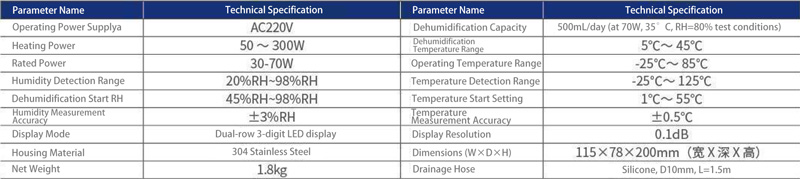
Product Features
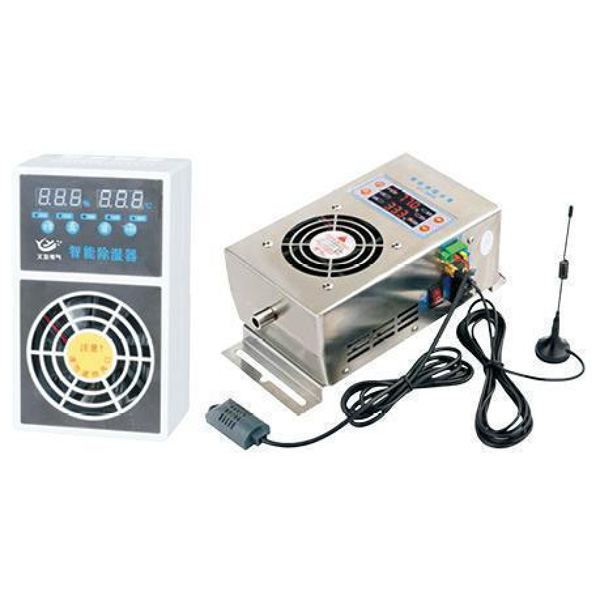
The intelligent dehumidification device consists of a power supply system, an air supply system, a semiconductor refrigerator, a temperature and humidity detection and control circuit, a heating circuit, a wireless module, and a drainage pipeline.
1. Dehumidification Principle
When humid air is drawn in by the fan, it flows through a specially designed air duct. It is first cooled and condensed by the semiconductor refrigerator. The condensed water droplets fall into the water collection tank under gravity and then flow out of the cabinet through the drain pipe. Through sufficient cyclic dehumidification within the set activation range, the humidity inside the cabinet is reduced below the dew point, completing the entire moisture-proof, condensation-inducing, and heating process. At the same time, the signal acquisition sensor of the intelligent dehumidification device is externally mounted, which can accurately collect the real humidity inside the cabinet in real time, ensuring that the device starts dehumidification in advance when condensation conditions are about to occur inside the cabinet.
2. Low-temperature Heating Function [Optional]
When the cabinet temperature is lower than the set activation value, the dehumidification device activates the internal heater circuit (heater is externally connected, with power range 50~300W). The heater circuit stops working when the cabinet temperature rises to the set activation value plus 5°C.
3. Wireless Remote Control Function [Optional]
When the dehumidification device with wireless control function receives data from the main control room, it analyzes the data and immediately sends a response back to the main control room. The wireless communication range can reach 2000 meters (line-of-sight).
4. RS485 Communication Function [Optional]
When the dehumidification device with RS485 communication function receives data from the host computer, it analyzes the data and immediately sends a response back to the host computer. One host computer can connect a maximum of 200 devices (it is recommended to connect a 120Ω load resistor between terminals A and B at the host computer end).
Wiring diagram
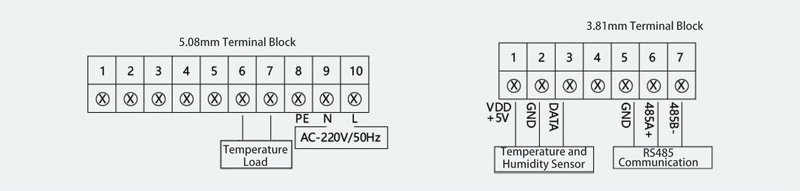
1. 5.08mm Terminal Block
a. Terminals 1-2-3-4-5: Unused (no load connected)
b. Terminals 6-7: Connect to temperature load
c. Terminals 8-10: Connect to AC220V power supply
2. 3.81mm Terminal Block
a. Terminals 1-2-3: Connect to temperature and humidity sensor
Terminal 1 (red wire): 5V power supply
Terminal 2 (black wire): GND
Terminal 3 (blue wire): Data I/O port
b. Terminal 4: Unused (no load connected)
c. Terminals 5-6-7: Connect to RS485 communication line
Terminal 2: GND
Terminal 4: 485-A+
Terminal 5: 485-B-
Note: The output relay's passive control contact has a rated resistive load of AC220V/3A. For higher power loads, users may connect an AC220V intermediate relay to the corresponding load to expand power capacity.
Phone: +86 18066329111
E-mail: liuran8020gmail.com
Address: Yanpan Industrial Zone, Yueqing City, Zhejiang Province









 Español
 Portugues
 Pусский
 العربية
 Türk dili
 Indonesia
 Tiếng Việt
 қазақ
қазақ فارسی
فارسی українська
 беларускі
 Filipino
 o'zbek
 български
 тоҷикӣ
 kiswahili
 Монгол
 አማራ
አማራ Ilocano



 WhatsApp
 Phone
Phone E-mail
 Message